
Recently, Meta launched its Muse product, a Personal AI Agent wrapped in a cute, cuddly form factor like a personal Tamogatchi assistant. It is, reportedly, very user friendly and bystander unfriendly. It is also a product rushed to market by a company with a known laissez-faire attitude toward privacy and security. I could write an entire article on the many problems with the Meta Muse, but instead, let's use these column inches to talk about the nascent Colorado Chatbot Safety Act.
What is the Colorado Chatbot Safety Act?
The Colorado Chatbot Safety Act is one of two pieces of Colorado legislation designed to replace the now-dead Colorado AI Act. In 2024, Colorado became the first state in the country to pass a general application AI regulation modeled, in some small part, after the EU AI Act. While it didn't go as far as prohibiting certain AI use cases the way the EU AI Act did, it focused on a lot of the high risk potential harms of AI and had a lot of the risk documentation, bias testing, and other requirements that the EU AI Act does.
Of course, Big Tech and its allies marshaled their government relations teams and sallied forth to get the Colorado AI Act repealed and replaced with two much lighter bills. One, the Colorado Automated Decision Making Technology ("ADMT") Law, focused on all AI and transparency and individual rights principles similar to California's Consumer Privacy Act's ADMT regulations that went into effect earlier this year. The other component was the Colorado Chatbot Safety Act, a very narrowly-tailored piece of legislation designed to prevent some of the most urgent harms propagated by chatbots: namely, sexual conversations and self-harm.
What does the Colorado Chatbot Safety Act Require?
The Colorado Chatbot Safety Act is effective on January 1, 2027 and has two goals:
- Require AI companies to build guardrails around sexually explicit communications and self-harm communications.
- Require AI companies to report to the Colorado Attorney General what its guardrails for sexually explicit and self-harm communications are, how many of these communications occur, and whether the guardrails and interventions are successful.
There are slightly different requirements for if the end-user is a minor under 18 versus and adult and the Colorado Chatbot Safety Act backdoors the content-neutral Age Verification Framework under California law into being for Chatbot companies. That is, if you are subject to this law (and more on this below), you'll have to ingest the Age Estimation signals from operating systems and app stores on which your Chatbot is made available and design differently for adults and minors.
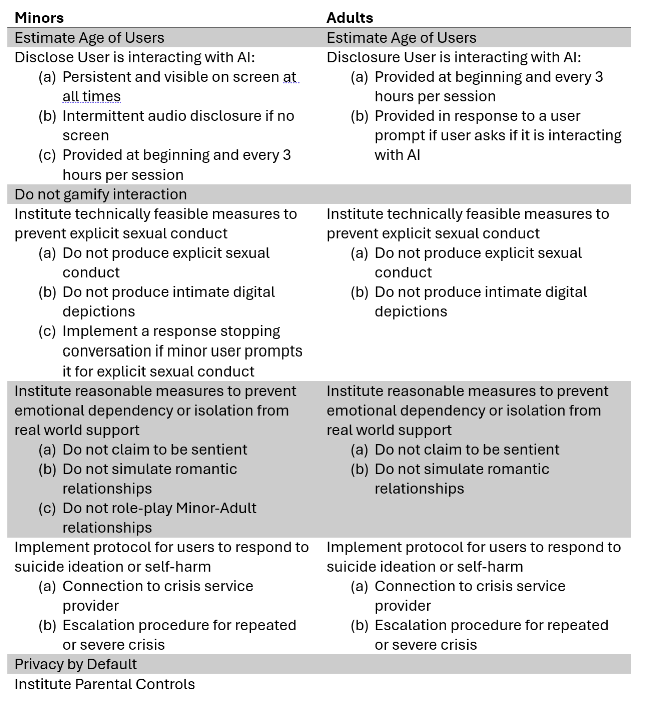
In addition to the above requirements, AI chatbots (again, if subject to this law) are prohibited from giving out advice and representing that they are equivalent to or as qualified as the following licensed professions:
- Health-care professional
- Legal professional
- Mental Health professional
- Dietician
This is clearly to protect users from relying upon bad advice by unlicensed professionals unbound by codes of ethics, training, and continuing education requirements. I would not be surprised to see this list expand (tax professionals?) in future legislative sessions.
Finally, the Colorado Chatbot Safety Act requires companies to submit reports on or after July 1, 2027, to the Colorado Attorney General with the following information:
- Number of times in a calendar year the operator of an AI has issued a referral to a crisis service provider;
- Protocols implemented to detect, remove, and respond to suicide ideation or self-harm;
- Protocols implemented to prevent a conversational response by AI about suicidal ideation or self-harm;
- Any additional metrics necessary to determine efficacy and reliability of safeguards and detection measures.
The reports must not include any personal information or identifiers of individuals and the Attorney General is directed publish aggregate data on its website. As of publication of this article, no submission portal or website has been established for these reports.
Who must comply with the Colorado Chatbot Safety Act?
Usually I write these analyses with this question first. After all, jurisdiction at the top means that if it doesn't apply to me, I don't have to even bother to read the rest of the article, but this one, I wanted to end with this one to leave a lasting impression: The Colorado Chatbot Safety Act is so essentially neutered and riddled with exemptions that you can essentially make a case that this law applies to very very few applications of AI enabled chatbots and personal agents. You can also very clearly map out where lobbyists got in there and secured an exemption for their technology. To wit, see my handwritten notes:
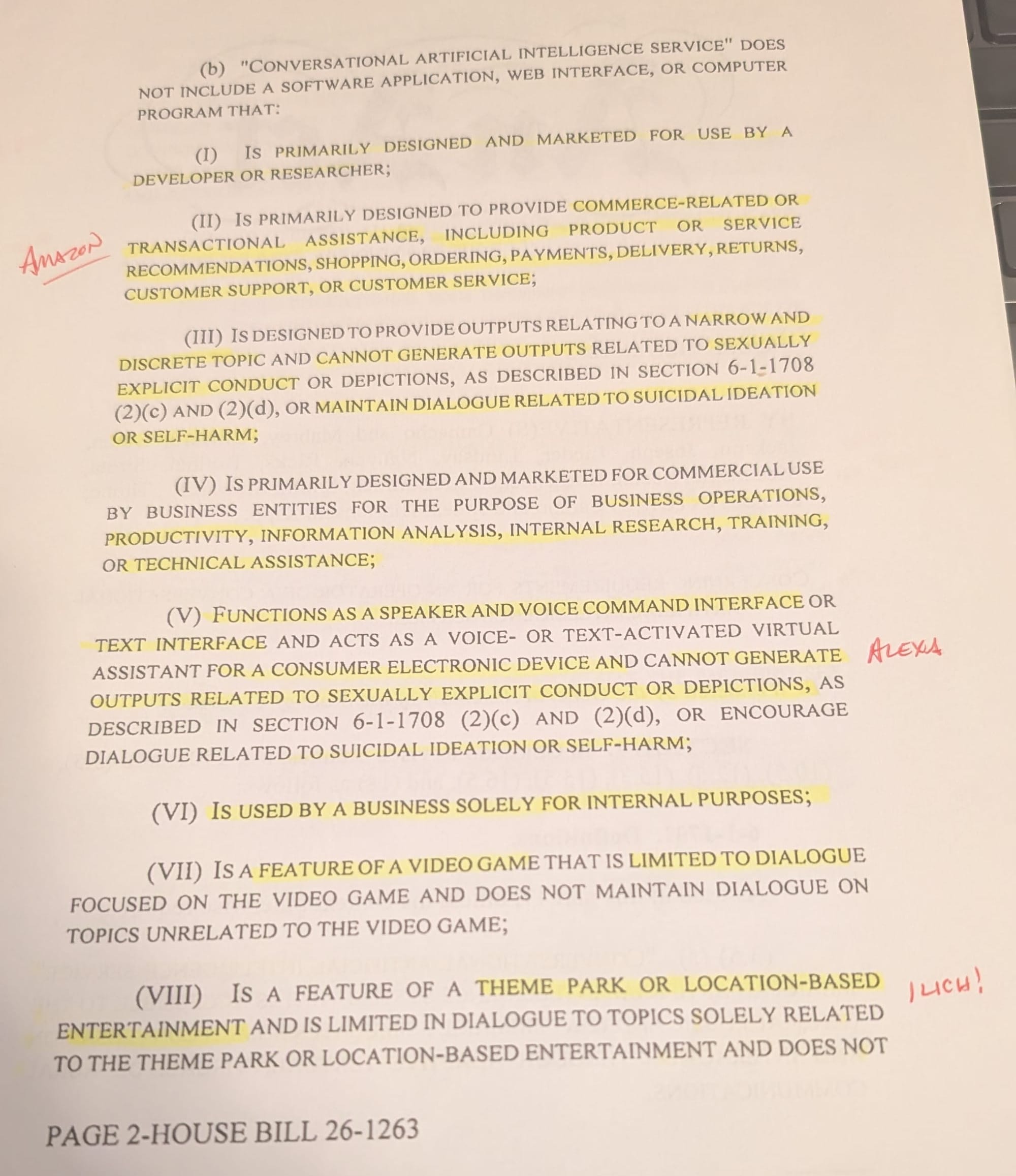
Looking at subsection (V), the "speaker and voice command interface" would seem to apply fairly broadly to the screenless Personal AI Agents launched by Meta and its competitors recently, but for the later piece of the exemption: "cannot generate outputs related to sexually explicit conduct or depictions." Because, as Wired reported, it took less than a week from public launch for a security researcher to get Meta to sext. But for the absolute failure of Meta's privacy, responsible AI, safety (pick your terminology) teams and the overwhelming ethos of Move Fast and Break Things, including the law, that permeates Meta under Zuckerberg's leadership, this law may not apply to Meta and its cuddly sext-bot.
Overall, more concerning than the laundry list of exemptions crafted for various entities based around their legislative outreach efforts and standard federally preempted fields like HIPAA and GLBA, is this last subsection (XII):
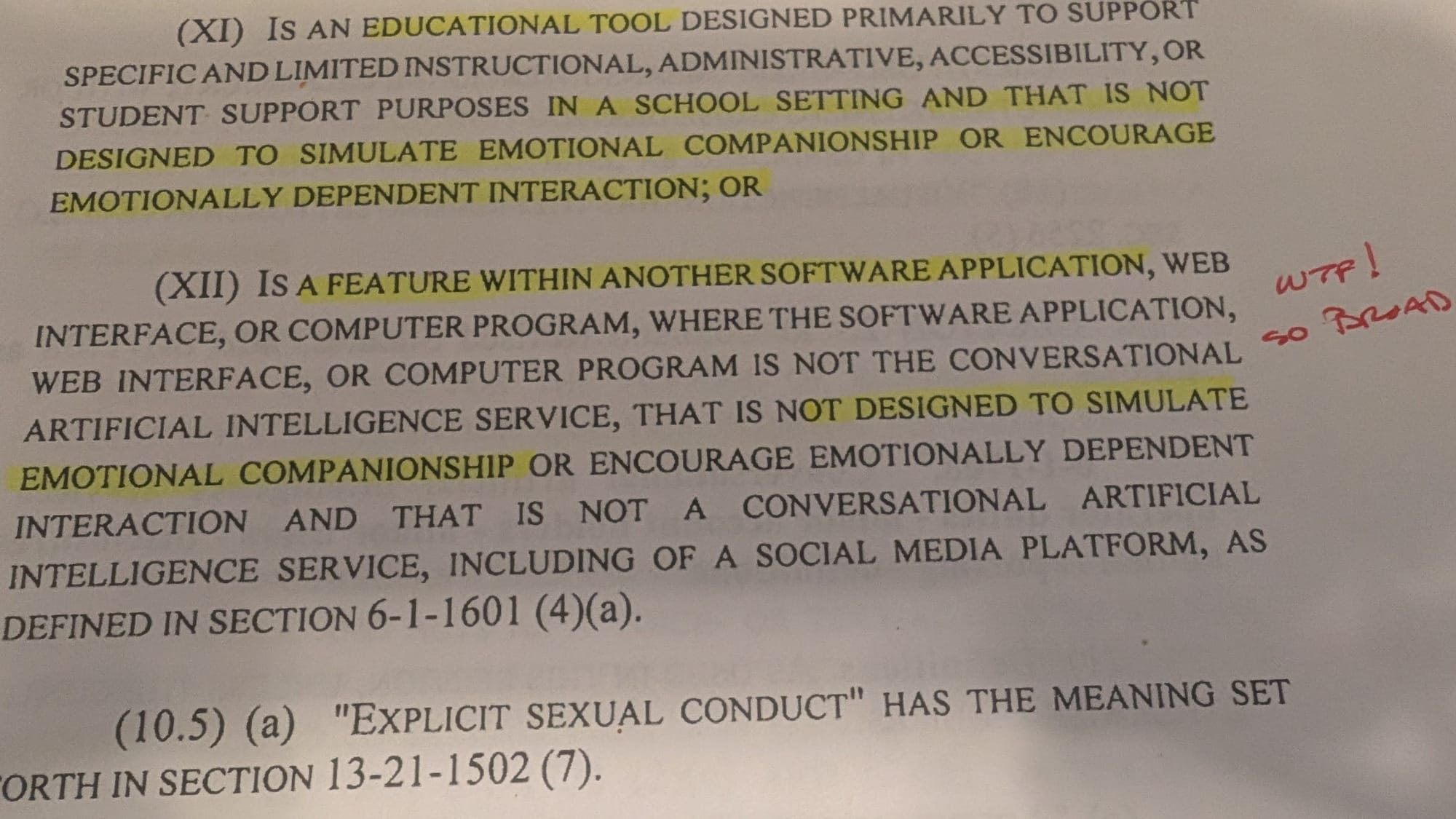
"Is a feature within another software application...not designed to simulate emotional companionship" is basically a Get-Out-Of-Jail-Free Card for so many chatbots.
There will be a metric ton of Attorney-Client Privileged Ink spilled on this question for organizations looking to exempt themselves from this law. After all, most software is not just a single program written in a garage or basement anymore, but is instead a series of connected components assembled like Lego. Generally, I'm not an attorney that goes hunting for loopholes and taking huge contorted leaps of logic that twists an argument and the plain language of the law into knots to avoid compliance, but in this instance, I'm not even sure you have to. With a laundry list (12 items!) of exclusions and a broad catchall that turns on whether your chatbot is embedded into something else, well, it's not a huge leap to say that the number of companies this will apply to is pretty small.
At the end of the day, looking at the CO Chatbot Safety Act, the question is fundamentally who does it apply to?
If you need any help navigating the Colorado Chatbot Safety Act or any other privacy, security, or AI laws, reach out to us at Brandi@BennettTechLaw.com for help.